Food Safety
One of AESAN’s functions is to propose risk-management measures relating to food. Among other things, it puts forward proposals for new regulatory developments and promotes the simplification and harmonisation of regulations.
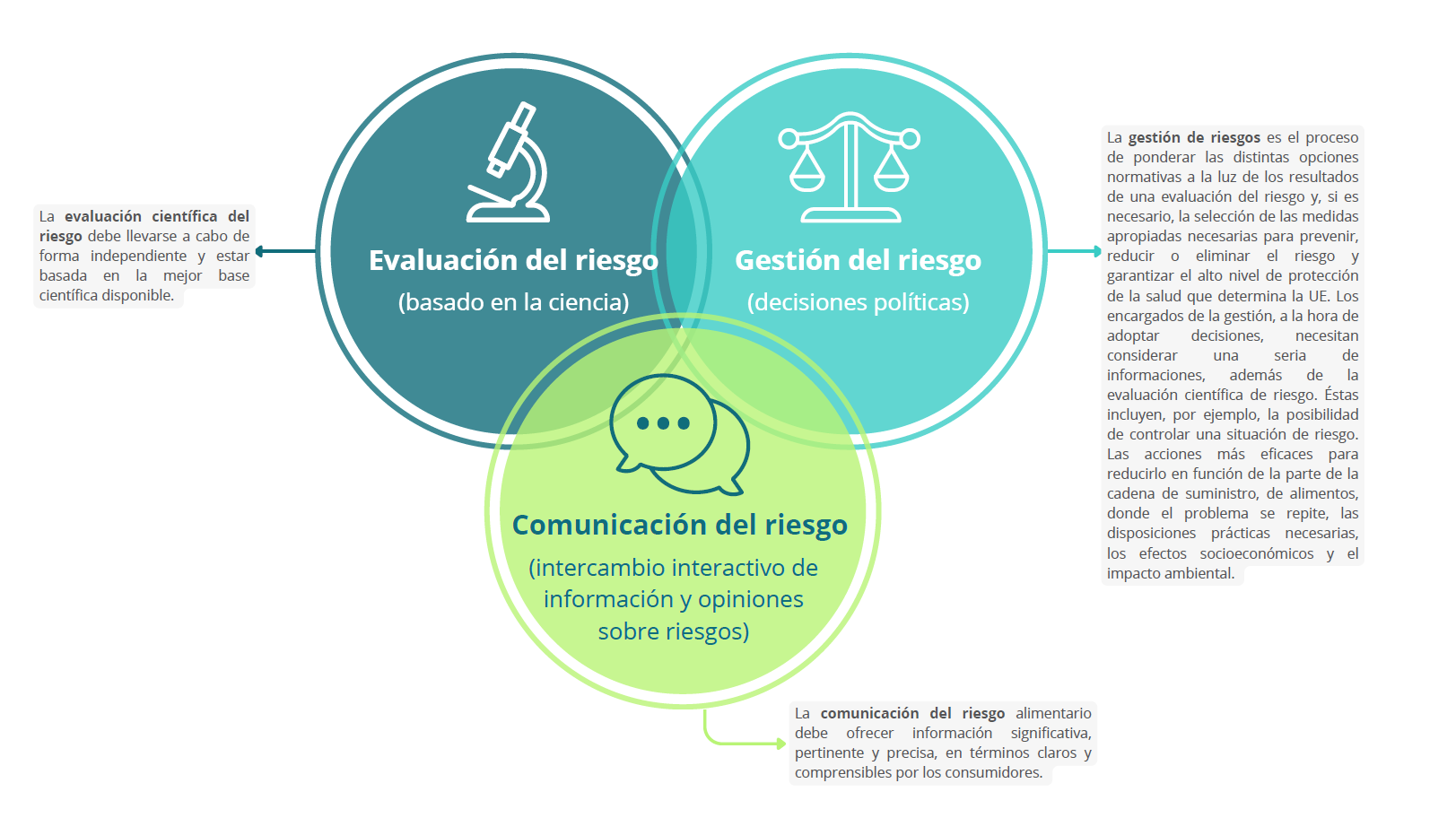
Risk management is one of the three components of risk analysis on which food safety policies at European Union level must be based: Risk assessment, risk management and risk communication.
Risk management is the process of weighing up the various regulatory options in the light of the results of a risk assessment and, where necessary, selecting the appropriate measures required to prevent, reduce or eliminate the risk and ensure the high level of health protection set by the European Union.
As managers, when making decisions, we need to take into account a range of information, in addition to the scientific assessment of risk. These include, for example, the ability to manage a risk situation, the most effective measures for mitigating that risk depending on the part of the food supply chain where the problem arises, the necessary practical arrangements, the socio-economic effects and the environmental impact.
In the various sections on this page, you will find specific information on the different hazards currently being assessed for risk, both at national level and at European Union level, and the risk management measures adopted for each of them.
General principles and requirements
The General Principles of Food Law are laid down in Articles 5 to 10 of Regulation (EC) No 178/2002 of the European Parliament and of the Council of 28 January 2002, laying down the general principles and requirements of food law, establishing the European Food Safety Authority and laying down procedures in matters of food safety, hereinafter referred to as the “Regulation”.
General objectives
Food legislation is designed to ensure a high level of protection for people’s lives and health, whilst taking into account animal welfare, plant health and the environment. All of this is based on the integrated “farm-to-table” approach, now regarded as a general principle of EU food safety policy.
This legislation establishes, at both national and EU level, consumers’ right to food safety and to accurate and truthful information. Its aim is to harmonise requirements across the EU in order to ensure the free movement of food and feed.
Risk analysis
The Regulation lays down the principles of risk analysis in relation to food, as well as the structures and mechanisms for scientific and technical assessment carried out by the European Food Safety Authority (EFSA).
Food legislation, and in particular measures relating to food safety, must be underpinned by a sound scientific basis. The Regulation stipulates that the three interrelated components of risk analysis (assessment, management and communication) form the basis of food law. Nevertheless, such legislation is not always based on scientific evidence; for example, legislation relating to consumer information or the prevention of misleading practices does not require a scientific basis.
Areas of Food Safety

Official control

Food hygiene

Biological hazards

Chemical contaminants

Residues of plant protection products and veterinary medicines

Food contact materials

Technological ingredients

Food information

Specific foods

New foods and biotechnology
Animal welfare
Codex Alimentarius
El Codex Alimentarius es un Programa Conjunto de la FAO y la OMS sobre Normas Alimentarias. La Comisión del Codex Alimentarius (CAC) es el máximo órgano decisorio, que delega en sus órganos auxiliares (Comités) la preparación de proyectos de normas u otros trabajos relacionados.
La AESAN como punto de contacto del Codex en España, realiza la función de enlace directo con la Secretaría del Codex Alimentarius conforme establece su manual de procedimiento. Asimismo, constituye un enlace con la Secretaría del Consejo de la UE en temas relacionados con el Codex, ya que la Unión Europea es miembro del Codex conforme a la Decisión 2003/822/CE y España como miembro de la Unión Europea, debe coordinarse con la Comisión UE y el resto de Estados Miembros.
Traceability
Traceability, defined in Regulation 178/2002 as the ability to identify and track a food, feed or ingredient through all stages of production, processing and distribution, is of crucial importance for consumer protection.
Specifically, it is a risk management tool that helps to facilitate the recall of foodstuffs in which a problem has been detected and enables consumers to receive specific and accurate information about the products in question.
To ensure traceability, food business operators, including importers, shall have a system in place that enables them to identify their immediate suppliers and their immediate customers, except where the latter are the end consumers (the ‘one step back, one step forward’ approach).
In accordance with Article 18(5) of Regulation 178/2002, Regulation 931/2011 lays down specific traceability requirements for food of animal origin, in order to ensure the correct application of the general requirements set out in Regulation 178/2002