Food Alert Network
Latest food alerts
Alerta por posible presencia de fragmentos de vidrio en frutos secos procedentes de España. (Ref. ES2026/712)
Advertencia para personas con alergia a la soja y/o el cachuete e intolerancia a los sulfitos: Presencia de soja, cacahuete y/o sulfitos en helados procedentes de España (Ref.ES2026/710)
Ampliación de información sobre la alerta por posible presencia de Salmonella Enteritidis en huevos procedentes de España. (Ref. ES2026/711)
Alerta por posible presencia de Salmonella Enteritidis en huevos procedentes de España. (Ref. ES2026/711)
The food alert network aims to protect human health and manage food risks. To this end, a coordinated food alert system is in place.
Its legal basis is set out in:
article 25 of Law 17/2011 on food safety and nutrition;
articles 50 to 52 of Regulation (EC) No. 178/2002, establishing the principles and general requirements of food law.
Within this system, AESAN acts as the national contact point for the following alert networks:
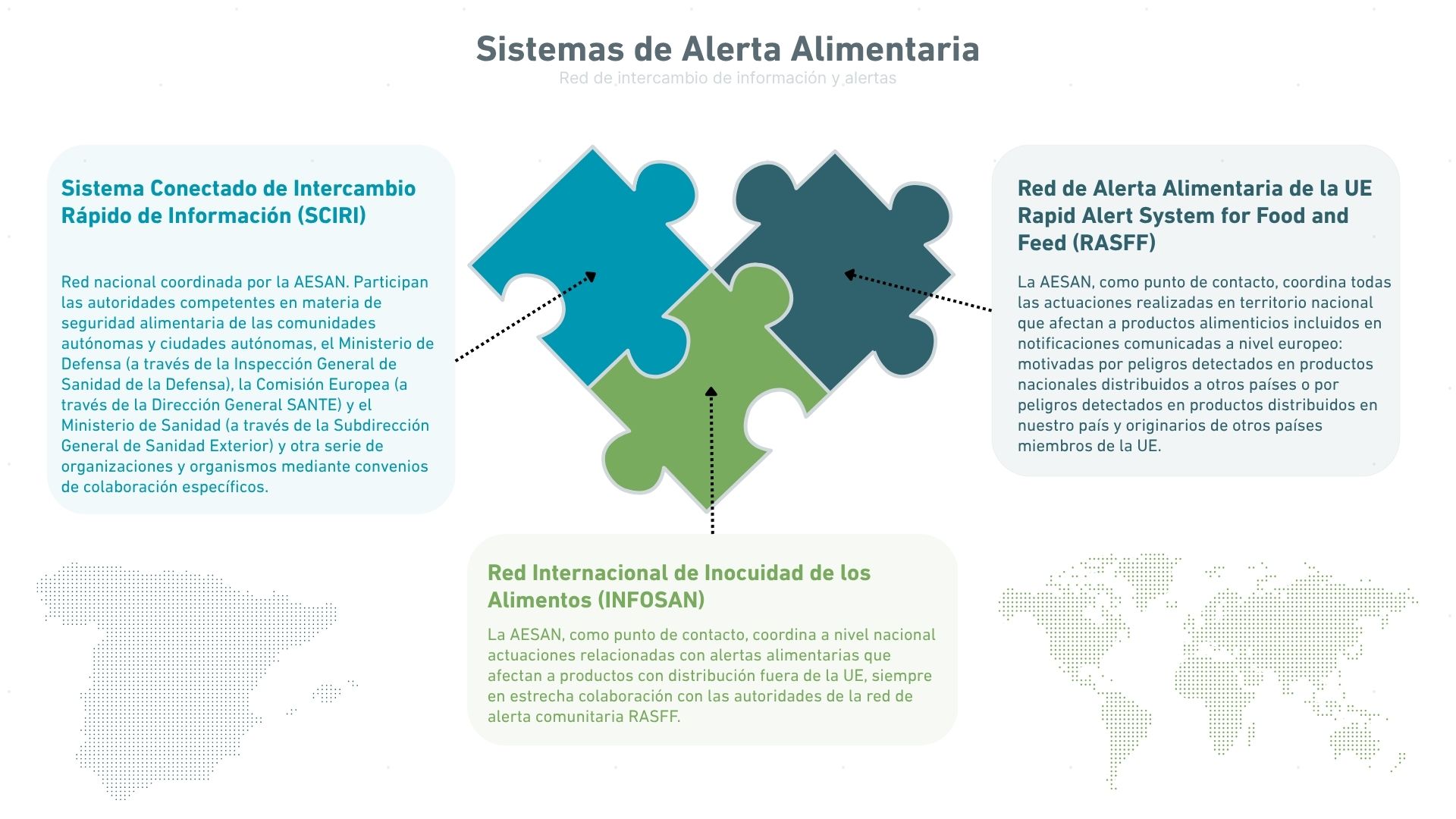
These networks enable constant monitoring of any food-related risks or incidents that could affect consumers’ health, thereby ensuring that the products available to them are safe and pose no risk to their health.
To achieve this objective, the cornerstone is the rapid exchange of information between the various relevant authorities, food businesses and consumers.
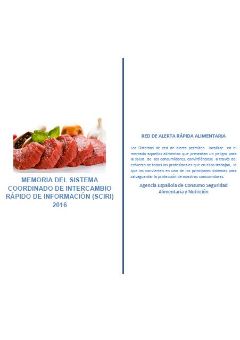
AESAN produces the SCIRI reports annually, which compile all information relating to alert network notifications that have affected our country, including a detailed description of the products involved, the hazards detected and the origin of the foodstuffs covered by the notifications.
The fact that a food alert procedure is initiated, at national or European level, does not mean that the products in question have reached the consumer, even if those foods have already entered the food supply chain in Spain. For this reason, not all cases reported on the European system (RASFF) are systematically communicated to the public in our country.
The reason for issuing an alert is that companies and the relevant authorities have identified certain unsafe products and are working against the clock to withdraw them, ultimately preventing them from being made available to the public.
Despite the rapid response of the food alert network, products subject to an alert may still reach the public; in such circumstances, new mechanisms are activated, primarily in the area of communication, to effectively inform the entire population and prevent those specific products from being consumed.
Therefore, the main aim of issuing a food alert is to inform the public whether a product that has been on sale poses a serious risk and, if they have bought it and have it at home, to prevent it from being consumed.
Criteria for the publication of food alerts on the website and social media channels of the Spanish Agency for Food Safety and Nutrition (AESAN)
When AESAN issues a food alert, I should check whether I have the product at home or whether I have consumed it.
It is important to know whether I am affected by the alert or not, as many alerts are not aimed at the general public but only at people with allergies or intolerances to certain substances. If I am not a vulnerable person, I do not need to worry.
If an alert might affect me, I should check the exact details of the product: its name and, in particular, the batch number and the use-by or best-before date. If the product I have at home does not match the one covered by the alert, there is no need to worry.
If the product has been consumed, the recommendations set out in the alert’s information note should be followed.
PLEASE NOTE: It is essential to obtain information from reliable sources, particularly from the official websites and social media channels of AESAN or the autonomous communities.
How should you respond to an alert published on the AESAN website?
It is an online database run by the European Commission on the Rapid Alert System for Food and Feed (RASFF), which features a search tool that allows users to view notifications on the RASFF Portal.
The food alerts published on RASFF Window are not intended to warn consumers; rather, they are part of the EU Member States’ information exchange system designed to respond swiftly and in a coordinated manner to a health threat caused by food, and thus:
prevent the products from reaching consumers;
trace all the products concerned and ensure they are withdrawn from the market to prevent them from being sold;
ensure that all products are properly removed from the supply chain;
take the necessary measures to prevent a recurrence.
For the sake of transparency, part of this database is public and accessible to any user, who can view the ‘visualisations’ via the website https://webgate.ec.europa.eu/rasff-window/
The publication of notifications on RASFF Window is the means of informing the contact points in the Member States of the existence of a risk associated with a product, and it is at this stage that investigations and measures aimed at protecting consumer health are initiated.
Consumer warnings regarding the risks associated with certain products are issued by economic operators and, where necessary, by AESAN and the autonomous communities, via their websites and social media channels.
Food alerts of interest to the general public: these are food alerts that must be made public, either because of their impact on public health or because they may be distributed to the end consumer.
Food alerts for people with allergies, intolerances or other adverse reactions to certain substances: these are alerts regarding the presence of certain ingredients or other substances or products not listed on the label which, when used in food production and still present in the finished product, may cause various health problems in some people, which in certain cases may pose a serious risk to their health. Three types are included here:
Allergens
Substances that cause intolerances
Gluten
Food alerts for people who take food supplements: these are alerts concerning the presence, amongst other substances, of pharmacologically active substances marketed as food supplements, in particular substances used to enhance sexual vigour, promote muscle growth or stimulate weight loss. These products are marketed without the necessary supervision and control by health authorities and therefore pose a serious risk to the health of those who consume them.
Report by the Food Alert Network
AESAN produces the SCIRI reports annually, which compile all information relating to alert network notifications that have affected our country, including a detailed description of the products involved, the hazards detected and the origin of the foodstuffs covered by the notifications.